Explore the night sky with a telescope designed for planets and stars. This guide highlights five reliable options, spanning beginner-friendly models and more advanced refractors, helping you observe lunar craters, planetary bands, star clusters, and distant galaxies. Each pick balances optics, ease of use, and accessories like tripods and phone adapters to enhance viewing and sharing discoveries.
| Product | Brand | Key Benefit |
|---|---|---|
| Telescope For Adults High Powered, 90mm Aperture | HETEKAN | Bright lunar and planetary detail with phone adapter |
| FAMIROSA Telescope For Beginners, 70mm | FAMIROSA | Easy entry into astronomy with versatile magnification |
| FAMIROSA Telescope For Adults High Powered, 90mm | FAMIROSA | Higher magnification range for planets and deep-sky views |
| Educational Insights GeoSafari Starview Telescope | Educational Insights | Kid-friendly start with guided learning and journal |
| Telescope For Adults & Kids 80mm Aperture | YENGUAN | Balanced beginner-to-intermediate performance with versatile eyepieces |
Note: The selections above focus on optics, ease of use, and accessories that support observing planets, the Moon, star clusters, and other celestial objects. Each product page provides more details on assembly, portability, and included extras.
Telescope For Adults High Powered, 90mm Aperture by HETEKAN

The HETEKAN telescope is designed for adults, kids, and beginners aiming to observe the Moon and planets closely. Its 90 mm aperture gathers ample light, producing brighter planetary and lunar features. Fully multi-coated optical lenses reduce reflections, supporting eye comfort during longer sessions. This model offers a flexible magnification setup with 36X-450X through three eyepieces plus a 3x Barlow lens, a 900 mm focal length, a 5×24 finder scope, and a phone adapter for quick image capture. A stable stargazing mount helps keep objects centered as you explore.
FAMIROSA Telescope For Beginners, 70mm Aperture

This beginner-friendly refractor offers a 70 mm aperture with fully coated optics for bright, clear views of stars and planets. A focal length of 500 mm supports practical viewing distances, while the 20X-150X magnification range covers wide star fields and detailed planetary glimpses. The kit includes two eyepieces (10 mm and 25 mm) and a 3X Barlow lens, aiding flexible magnification. An included carry bag, adjustable tripod, and phone holder add portability and quick sharing of discoveries for both day and night use.
FAMIROSA Adults High Powered, 90mm Aperture
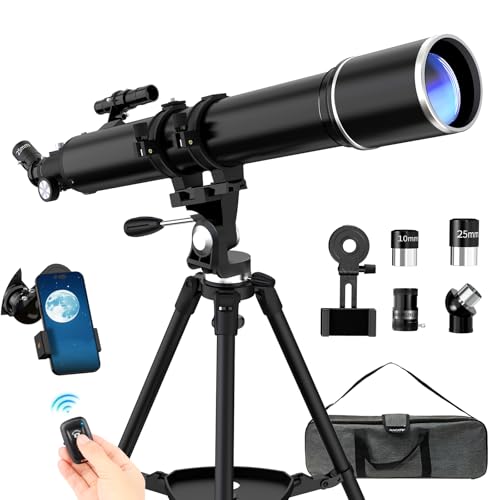
This 90 mm aperture telescope emphasizes clear optics and broad planetary coverage. With a focal length of 900 mm, it scales from 36X to 270X using two eyepieces (10 mm and 25 mm) and a 3x Barlow lens. The fully coated glass lenses maximize light transmission, producing crisp images of planets and lunar details. A dedicated bag, tripod, and phone adapter provide convenient transport and easy sharing of photos and videos captured during night-sky sessions or daytime terrestrial viewing.
Telescope For Adults & Kids 80mm Aperture By YENGUAN

The YENGUAN 80 mm aperture model targets beginners and families. It combines multi-coated optics with an achromatic objective lens to deliver brighter, higher-contrast images of the Moon’s craters and nearby planets. Magnification ranges from 24X to 180X via 25 mm and 10 mm eyepieces plus a 3x Barlow lens. The alt-azimuth mount supports easy adjustments, while included assembly guidance and a finderscope facilitate quick alignment for both celestial and terrestrial viewing.
Wow in The World Kids’ Telescope & Astronomy Kit

Designed for younger skywatchers, this beginner refractor introduces astronomy with two eyepieces (25x and 50x) and an adjustable tripod up to 48 inches. It includes an illustrated Wow-To Guide to help kids identify Moon craters, planets, and constellations. The kit emphasizes a hands-on learning approach, aligning with STEM education and family science activities. It is a practical first telescope that supports a guided, curiosity-driven exploration of the night sky.
Buying Guide: Key Purchase Considerations
- Light-gathering power and aperture: Larger apertures collect more light, improving visibility of faint objects but often increase weight and setup complexity. For planets, lunar details, and brighter deep-sky features, a 70–90 mm class is a solid balance for beginners and intermediate users.
- Focal length and magnification: Longer focal lengths (e.g., 900 mm) enable higher magnification with minimal image blur when aligned properly. Look for a combination of eyepieces (e.g., 10 mm and 25 mm) plus a Barlow lens to expand the magnification range.
- Optical coatings: Fully multi-coated optics reduce reflections and improve brightness, contrast, and eye comfort during extended sessions.
- Mount and stability: A stable alt-azimuth or equatorial mount helps keep objects centered. Tripod quality influences shaking and ease of tracking across the sky, especially at higher magnifications.
- Accessories: Phone adapters, finderscopes, additional eyepieces, and carrying bags add value by enabling easy imaging and transport. For kids, included guides or activity journals can enhance learning.
- Target user and goals: Beginners benefit from simpler setups and guided learning, while more experienced observers may prioritize higher aperture and flexible magnification for planetary details and deep-sky views.
- Portability and storage: Consider weight, size, and whether the telescope is easy to assemble and disassemble for travel or field use.
Overall, selecting a telescope for planets and stars involves balancing aperture, magnification range, optics quality, and user-friendly features. The options listed provide a mix of beginner-friendly and more capable refractors to suit different observing goals, light conditions, and budgets.
Add a Comment