Choosing a console dive computer combines on-wrist data with quick access on a single display. This guide highlights five of the most relevant console-style dive computers that prioritize readability, intuitive controls, and smart connectivity options for divers in the American market.
The following table compares the chosen models, focusing on display clarity, gas management, Bluetooth or app compatibility, and key planning features. These summaries help you assess which console unit best fits your dive style and data needs.
| Product | Brand | Key Feature | Connectivity | Ideal For |
|---|---|---|---|---|
| Oceanic Pro Plus 4.0 Dive Computer | Oceanic | Large, readable display with attached compass | Bluetooth to DiverLog+ app | |
| Mares Mission Puck 3 Console | Mares | Compact gauge with integrated analog compass | Manual controls, basic integration | |
| Cressi Donatello 3 Console | Cressi | All-in-one with computer, compass, gauge | Single-button operation | |
| Shearwater Peregrine Dive Computer Console | Shearwater Research | Vibrant display, long battery life | Rechargeable battery, multiple gases | |
| Aqua Lung i550C Dive Computer | Aqualung | Bluetooth with DiverLog+ mobile app | Smartphone app control |
Note: All products listed are console-style dive computers with integrated gauges or modular designs that favor quick monitoring and ease of use during dives and pre/post-dive planning. Features vary by model, including display size, gas management capabilities, and app connectivity.
Oceanic Pro Plus 4.0 Dive Computer

The Oceanic Pro Plus 4.0 Computer features a large, easy-to-read display designed to reduce eye strain under water. An attached compass simplifies navigation, while Bluetooth connectivity enables sync with the DiverLog+ app on a smartphone for pre-dive planning. Users can adjust dual nitrox mixes, apply the Dual Algorithm, and manage gas mixes from a mobile device. Post-dive functionality allows quick download of dives, review of recent profiles, and the option to add photos or videos for a richer dive log.
Mares Mission Puck 3 Console

The Mares Mission Puck 3 Console combines a compact pressure gauge with an integrated analog compass, housed in a durable chrome-plated brass body for reliability. It uses a single-button operation system to access dive modes and settings, including air, nitrox, and bottom timer modes. The integrated analog compass provides straightforward navigation, helping divers maintain accurate bearings while exploring. Its compact design is well-suited for divers seeking a practical, uncluttered console without sacrificing essential data readouts.
Cressi Donatello 3 Console
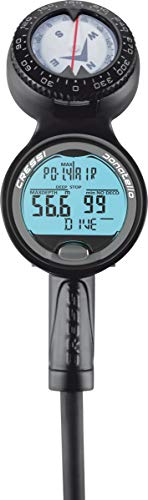
The Donatello 3 Console from Cressi combines a robust computer, compass, and pressure gauge in a single unit. It uses a single-button interface to switch between air, nitrox, gauge, and free modes. The high-definition screen provides large numerical displays for easy readability in various lighting conditions. This setup is ideal for divers new to the sport or those who value straightforward operation with all essential data presented in one place.
Shearwater Peregrine Dive Computer Console

The Shearwater Peregrine Console offers a vibrant 2.2″ color LCD with 320×240 resolution for clear visibility at depth. It supports extended dive time with a rechargeable Li-ion battery and allows seamless gas switching among up to three OC gases, including Nitrox compatibility. The combination of a bright display, long battery life, and flexible gas options makes it a strong choice for divers who need robust data visibility and customization during complex dives.
Aqua Lung i550C Dive Computer

The Aqua Lung i550C emphasizes wireless connectivity via Bluetooth with the DiverLog+ app. This enables remote control of all i550C settings, viewing dive logs and profiles, and adding locations, notes, photos, and videos to each dive entry. The console integrates easy data transfer and sharing capabilities, making it a practical option for divers who prefer mobile-assisted dive logging and post-dive documentation.
Buying Guide
Display readability and user interface: Look for large digits, high-contrast screens, and intuitive button layouts. A well-placed compass or user-friendly navigation helps maintain orientation during dives.
Gas management and algorithms: Consider the gas options you use (air, nitrox, trimix) and whether the device supports multiple gas switches, gradient factors, or dual algorithms for more complex dives.
Connectivity and data sharing: Bluetooth or Wi‑Fi integration with a mobile app (such as DiverLog+ or equivalent) can streamline pre-dive planning, log retention, and post-dive analysis. Check the app’s compatibility with your phone (iOS/Android) and its ability to export or share dive data.
Battery life and charging: Longer battery life reduces downtime between dives. Rechargeable batteries are convenient for frequent divers, but availability of spare batteries can be a factor for remote locations.
Durability and form factor: Console configurations favor a compact, robust build with solid gauges and protected screens. If you travel often, consider a model with a quick-disconnect fitting or modular design for ease of packing and maintenance.
Ease of use for different experience levels: Beginners benefit from devices with straightforward modes and a clear layout, while experienced divers may prefer more advanced settings and customizable displays.
Price and ecosystem: Compare not just the initial cost but also the ecosystem of accessories, spare parts, and compatibility with your preferred dive computers or pulse of software updates over time.
Add a Comment